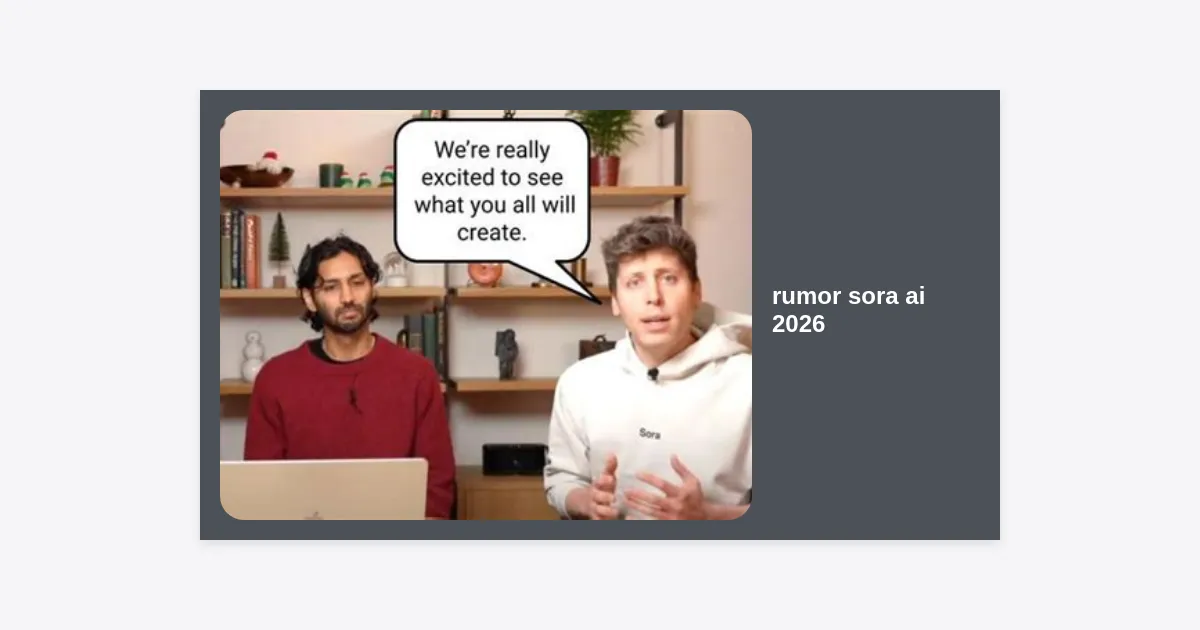
When OpenAI first pulled back the curtain on Sora in early 2024, the digital world stood still. We saw hyper-realistic videos of mammoths walking through snowy fields and neon-lit Tokyo streets that looked indistinguishable from high-budget cinematography. However, as the initial shock wore off, a nagging question emerged: When can we actually use it? Recently, the rumor sora ai 2026 has begun circulating among tech insiders and AI enthusiasts, suggesting that the public release of this world-simulating model might be further off than we anticipated. In this comprehensive guide, we will dive deep into why a 2026 timeline is being discussed, what technical hurdles OpenAI faces, and how you can prepare for a future dominated by generative video.
Table of Contents
- The Origin of the Rumor: Sora AI 2026 timeline
- Understanding Sora: More Than Just a Video Generator
- Technical Bottlenecks: Compute, Energy, and Scaling
- Safety first: Why OpenAI is Taking Its Time
- The Competition: Runway, Luma, and Kling AI
- Actionable Advice: Preparing for the 2026 AI Video Era
- Economic Impact: How Sora Will Change Industries
- Frequently Asked Questions
- Conclusion: The Long Road to Sora
The Origin of the Rumor: Sora AI 2026 Timeline
Speculation regarding a rumor sora ai 2026 release date stems from several logistical and strategic realizations within the AI industry. While OpenAI initially showcased Sora to a limited group of visual artists and red-teamers, the broad public access has remained elusive. Why would a company wait two years to release its most hyped product? Expert analysts point to three main factors: hardware constraints, safety alignment, and market timing.
Firstly, the sheer computational power required to generate high-definition video at scale is astronomical. In 2024, the global supply of H100 GPUs is still catching up with demand. By projecting a 2026 date, insiders suggest OpenAI may be waiting for next-generation hardware (like NVIDIA’s Blackwell architecture) to become widely available to support a user base of millions without crashing the infrastructure.
Understanding Sora: More Than Just a Video Generator
Before diving into the delays, we must understand what makes Sora different. Sora is not just a “video maker”; OpenAI describes it as a “world simulator.” It uses a Diffusion Transformer (DiT) architecture, which allows it to understand the physics of the real world better than previous models. Unlike early AI video tools that often had “wobbling” backgrounds or morphing limbs, Sora maintains consistency in 3D space.
According to technical reports, Sora treats video as a collection of “patches,” similar to how GPT-4 treats text as tokens. This allows it to generate up to 60 seconds of high-quality video. However, generating 60 seconds of Sora-quality footage currently takes a significant amount of time—sometimes hours for a single clip. This inefficiency is a primary driver behind the rumor sora ai 2026, as the engineering team works to optimize the model for real-time or near-real-time generation.
Technical Bottlenecks: Compute, Energy, and Scaling
To understand the 2026 rumor, one must look at the numbers. Training a model of Sora’s caliber is estimated to cost hundreds of millions of dollars in compute time. But the cost of inference—letting users generate videos—is where the real financial drain lies. For OpenAI to offer Sora as part of a $20/month subscription, they need to reduce inference costs by at least 10x to 50x.
- Energy Consumption: Data centers are reaching their power limits. A site-wide Sora launch would require unprecedented energy stability.
- Data Scarcity: High-quality video data is harder to scrape than text. OpenAI has been in negotiations with major studios and licensing bodies (like Shutterstock) to ensure their training data is ethically sourced and legally sound.
- Latency: Users expect results in minutes, not hours. Optimizing the diffusion process for speed is a massive hurdle.
Safety First: Why OpenAI is Taking Its Time
OpenAI’s leadership has repeatedly stated that safety is their top priority. In an era of deepfakes and misinformation, releasing a tool that can create photorealistic propaganda is a significant risk. This is a strong supporting factor for the rumor sora ai 2026. OpenAI needs to build robust “watermarking” and detection tools before unleashing the model to the public.
“If you can create a video of anything, the world needs to be able to verify what is real and what is generated. We cannot rush that process.”
The company is currently working with the C2PA (Coalition for Content Provenance and Authenticity) to implement metadata standards. Furthermore, the 2024 global election cycle has put AI companies under the microscope. Waiting until well after these elections to release a wide-scale video generator is a strategically sound move to avoid political fallout.
The Competition: Runway, Luma, and Kling AI
OpenAI does not exist in a vacuum. While the rumor sora ai 2026 suggests a delay, competitors are moving at lightning speed. Runway Gen-3 Alpha and Luma Dream Machine are already available to the public, offering impressive, though perhaps slightly less consistent, results. In China, Kling AI has emerged as a powerhouse, capable of generating 2-minute videos that rival Sora’s quality.
The pressure from these competitors might force OpenAI to release a “limited beta” or a “Sora Lite” version before 2026. However, if OpenAI wants to maintain its brand as the “gold standard” of AI, they may ignore the pressure and stick to a 2026 timeline to ensure their product is significantly superior to anything else on the market.
Actionable Advice: Preparing for the 2026 AI Video Era
Whether Sora arrives tomorrow or the rumor sora ai 2026 holds true, the era of AI video is inevitable. Here is how professionals should prepare:
- Master Prompt Engineering for Visuals: The skills you learn today on Midjourney or Runway will translate to Sora. Learn how to describe lighting, camera angles (cinematography), and material textures.
- Focus on Storytelling: AI can generate shots, but it cannot currently construct a compelling narrative arc. Spend your time learning screenwriting and storyboarding.
- Integrate AI into Your Workflow Today: Don’t wait for Sora. Use tools like Luma or Runway to enhance your current social media or marketing content. This builds the muscle memory of an “AI Director.”
- Stay Ethical: Understand the legal landscape of AI-generated content. Ensure your business models don’t rely on deceptive deepfakes.
Economic Impact: How Sora Will Change Industries
If the rumor sora ai 2026 is true, industries have a two-year grace period to adapt. Let’s look at the projected impact:
Marketing and Advertising
Small businesses that previously couldn’t afford $50,000 commercial shoots will be able to generate high-end ads for pennies. This democratizes high-production-value marketing but creates a saturated market where creative vision becomes the only differentiator.
Education and Training
Sora could revolutionize educational content. Instead of reading about the French Revolution, students could watch a tailored, 60-second historically accurate simulation. By 2026, we might see the first AI-generated textbooks where every chapter includes a unique video explanation.
Hollywood and Cinema
While Sora might not replace 2-hour feature films immediately, it will fundamentally change pre-production. Directors will use it for “previz” (pre-visualization), allowing them to see a scene before they ever step onto a physical set. This could potentially save millions in production costs.
Frequently Asked Questions
Is the rumor sora ai 2026 confirmed by OpenAI?
No, OpenAI has not officially confirmed a 2026 release date. The rumor sora ai 2026 is based on industry analysis of compute requirements, safety protocols, and current beta-testing cycles. OpenAI has only stated it will be released “when it’s safe.”
Can I try Sora right now?
Currently, Sora is only available to a select group of visual artists, designers, and filmmakers, as well as red-teamers who are testing the model for vulnerabilities. There is no official public beta at this time.
What makes Sora different from Runway or Luma?
Sora is built on a Diffusion Transformer architecture that allows for better temporal consistency and a deeper understanding of physical interactions (e.g., a person biting a cookie and leaving a bite mark). Most current competitors still struggle with these complex physical details.
Conclusion: The Long Road to Sora
The rumor sora ai 2026 might feel like a letdown to those eager to experiment with this world-changing technology. However, a measured release is likely beneficial for society. It gives us time to build detection tools, update copyright laws, and allow creators to adapt their workflows.
Key Takeaways:
- Sora is a high-cost, high-compute world simulator that requires significant optimization.
- Safety and watermarking are the primary reasons for potential delays.
- Competitors like Kling and Runway are filling the gap in the interim.
- Professionals should focus on narrative and prompt engineering now to be ready for the eventual launch.
As we eye the 2026 horizon, the focus shifts from “if” to “how.” How will we use these tools responsibly? How will we define creativity when pixels are generated by prompts? The wait for Sora might be long, but the impact will be permanent. Keep your eyes on official OpenAI updates, but prepare for a future where your imagination is the only limit to what you can project on a screen.