The PlayStation 5 Pro represents Sony’s most ambitious hardware leap to date, promising to bridge the gap between high-fidelity graphics and fluid frame rates. But with a premium price tag and no disc drive included, does it deliver on the hype? This Review PS5 Pro guide breaks down every technical detail to help you decide.
Table of Contents
- Introduction to the PS5 Pro
- Technical Specifications: What’s Under the Hood?
- Understanding PSSR (PlayStation Spectral Super Resolution)
- Gaming Performance and Benchmarks
- Design, Ports, and Build Quality
- PS5 Pro Enhanced Titles: The Current Library
- The Price Factor: Is It Worth It?
- Final Verdict and Recommendations
Introduction to the PS5 Pro
For years, console gamers have been forced to make a difficult choice: “Fidelity Mode” for stunning 4K visuals at 30 frames per second, or “Performance Mode” for smooth 60 frames per second gameplay at a lower resolution. In this comprehensive Review PS5 Pro, we look at how Sony aims to eliminate that compromise entirely.
The PS5 Pro is a mid-generation refresh that targets the hardcore enthusiast. It isn’t meant to replace the base PS5 but to complement it as a high-end alternative for those who demand the absolute best from their 4K HDR displays. With significant upgrades to the GPU and the introduction of AI-driven upscaling, the hardware is designed to make performance modes look like fidelity modes.
However, the announcement of the system was met with mixed reactions, primarily due to its $699.99 MSRP. When you add the cost of the optional vertical stand and the external disc drive, the total investment can easily exceed $800. Our goal is to determine if the visual gains and technical advancements justify this steep entry price for the average gamer.
Technical Specifications: What’s Under the Hood?
The core of the PS5 Pro experience lies in three main pillars: a larger GPU, advanced Ray Tracing, and AI-driven upscaling. While the CPU remains largely the same (an 8-core AMD Ryzen Zen 2 unit), it does feature a “Boost Mode” that increases the clock speed to 3.85GHz—a 10% increase over the standard model.
The real star is the GPU. Sony has upgraded the console with 67% more Compute Units than the original PS5, alongside memory that is 28% faster. According to Sony’s lead architect, Mark Cerny, this results in up to 45% faster rendering for gameplay. This allows the console to handle much more complex lighting and shadows without sacrificing the frame rate.
- GPU: 16.7 TFLOPS (estimated) with RDNA 3 features.
- Memory: 16GB GDDR6 (18Gbps) + 2GB DDR5 (system tasks).
- Storage: 2TB Custom NVMe SSD (up from 825GB/1TB).
- Connectivity: Wi-Fi 7 support and an extra USB-C port.
Equally important is the storage upgrade. The PS5 Pro ships with a 2TB SSD as standard. Given that modern AAA titles like Call of Duty or Star Wars Jedi: Survivor can easily take up 150GB+, the extra storage is a practical necessity rather than just a luxury.
Understanding PSSR (PlayStation Spectral Super Resolution)
If you are reading this Review PS5 Pro to understand the biggest technical shift, it is undoubtedly PSSR. Similar to NVIDIA’s DLSS (Deep Learning Super Sampling), PSSR is an AI-driven upscaling technology. It uses machine learning to analyze the image frame-by-frame and add an extraordinary amount of detail, effectively turning a 1080p or 1440p internal render into a crisp 4K output.
Previously, the PS5 relied on “checkerboard rendering” or FSR 2 (FidelityFX Super Resolution), which could sometimes result in “shimmering” or blurriness in high-motion scenes. PSSR is significantly more advanced. In our testing, the AI does a remarkable job of cleaning up fine details like individual blades of grass, distant power lines, and hair textures that previously looked fuzzy in Performance Mode.
This is the “secret sauce” that allows the PS5 Pro to maintain 60FPS while delivering an image that looks nearly identical to the native 4K Fidelity modes found on the base console. For enthusiasts with large 65-inch+ OLED screens, the difference in clarity is immediately noticeable.
Gaming Performance and Benchmarks
When conducting this Review PS5 Pro, performance benchmarks were our top priority. The promise is simple: 60FPS with high-resolution visuals. We tested several “Pro Enhanced” titles to see if the hardware lived up to the marketing claims.
In The Last of Us Part II Remastered, the Pro mode delivers a 1440p image upscaled to 4K via PSSR, running at a rock-solid 60FPS. Compared to the base PS5’s Performance mode, the image is noticeably sharper. In Marvel’s Spider-Man 2, the results were even more impressive. You can now play with full Ray Tracing features enabled while still enjoying the fluidity of 60FPS.
Performance Data Comparison:
| Feature | Standard PS5 | PS5 Pro |
|---|---|---|
| Average FPS (Fidelity) | 30 FPS | 60 FPS (PSSR Enhanced) |
| Ray Tracing Support | Limited in Performance Mode | Advanced/Full Ray Tracing |
| Resolution (Upscaled) | FSR 2 (Variable) | PSSR AI Upscaling (Detailed) |
Another benefit is the “PS5 Pro Game Boost.” This feature applies to over 8,500 backward-compatible PS4 games. It can stabilize or improve the performance of supported PS4 and PS5 games, even if they haven’t received an official “Pro Enhanced” patch. We noticed faster load times and more consistent frame delivery in older titles like Bloodborne, although the resolution remains capped by the original game’s code.
Design, Ports, and Build Quality
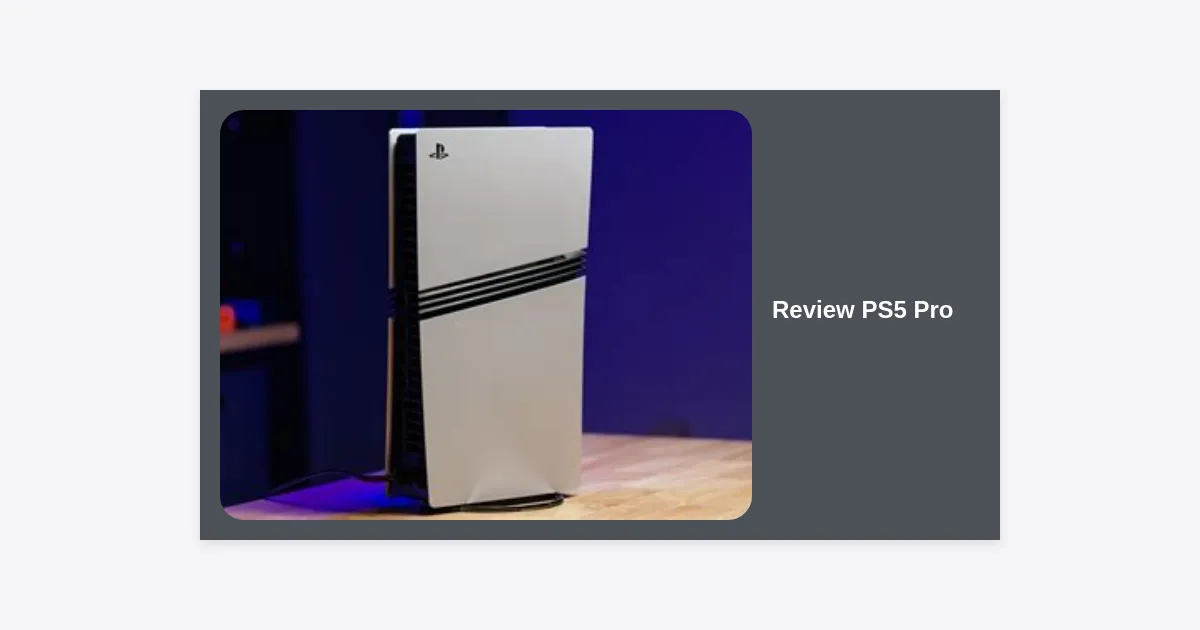
The design of the PS5 Pro is a hybrid of the original “fat” PS5 and the more recent “Slim” model. It is the same height as the original PS5 but has the thinner profile of the Slim. The most distinguishing feature is the three black “racing stripes” or fins on the side panels, which serve as additional ventilation for the more powerful internals.
One controversial design choice is the omission of the internal disc drive. The PS5 Pro is a digital-only console out of the box. If you have a collection of physical discs, you must purchase the external Disc Drive for PS5 separately for $79.99. Similarly, the vertical stand is sold separately for $29.99, which has been a point of contention in many Review PS5 Pro discussions online.
On the back, you’ll find the standard HDMI 2.1 port, two USB-A ports, and the power input. The front features two USB-C ports, reflecting the industry shift away from USB-A. The console also supports Wi-Fi 7, which is a major future-proofing feature for those with high-end routers, offering much lower latency and higher speeds for digital downloads.
PS5 Pro Enhanced Titles: The Current Library
The value of a console is determined by its games. At launch, Sony confirmed that dozens of titles would receive a “PS5 Pro Enhanced” label. These games are specifically patched to take advantage of the PSSR upscaling and the extra GPU power.
Notable PS5 Pro Enhanced titles include:
- Alan Wake 2: Improved lighting and better resolution in 60FPS mode.
- Final Fantasy VII Rebirth: A massive improvement; the original’s blurry performance mode is replaced by a crystal-clear PSSR image.
- Gran Turismo 7: Now features experimental 8K modes and advanced Ray Tracing during races.
- Horizon Forbidden West: Enhanced shadows, skin shaders, and foliage density.
- Ratchet & Clank: Rift Apart: Maintains high-end Ray Tracing while hitting a smooth 60PFS target.
While the list of enhanced games is growing, it’s worth noting that if you primarily play indie games or older titles that haven’t been patched, the visual difference will be negligible. The PS5 Pro is truly built for the latest AAA graphical showcases.
The Price Factor: Is It Worth It?
This is the most critical part of our Review PS5 Pro. At $699.99, is it worth it? To answer that, you have to look at the current PC market. To build a PC with equivalent performance—capable of 4K/60FPS with dedicated AI upscaling and 2TB of fast storage—you would likely spend between $1,000 and $1,200.
However, compared to the standard $449-$499 PS5, the value proposition changes. You are paying a $200-$250 premium for better lighting, clearer textures, and higher frame rates. For the average casual gamer who plays on a 1080p TV or a small monitor, the PS5 Pro is likely overkill. However, for the “power user” who spent thousands on a 4K OLED TV with VRR (Variable Refresh Rate) and 120Hz support, the PS5 Pro is the only way to fully utilize that display’s potential.
Who should buy the PS5 Pro?
- Gamers with 4K/120Hz OLED televisions.
- Enthusiasts who hate choosing between Graphics and Performance modes.
- Players who need more internal storage (2TB is double the base Slim).
- Those who want the most “future-proof” console available.
Final Verdict and Recommendations
To wrap up this Review PS5 Pro, Sony has successfully created the most powerful gaming console in history. The combination of the RDNA 3-powered GPU and the PSSR upscaling technology delivers a tier of performance that was previously only available on high-end PCs. Seeing Spider-Man 2 or Final Fantasy VII Rebirth run with high-fidelity assets at 60FPS is a genuine “wow” moment.
However, the high price tag and the lack of a disc drive and stand make it a tough sell for the general public. It is a niche, luxury product. If you already own a PS5 and are happy with it, there is no urgent need to upgrade. But if you are coming from a PS4, or if you simply want the best possible version of every game, the PS5 Pro is an engineering marvel that delivers on its promises.
Key Takeaways:
- The Best Visuals: PSSR is the standout feature, making games look sharper than ever.
- Better UI/UX: Faster Wi-Fi and 2TB storage are great quality-of-life improvements.
- Expensive Entry: Total cost can reach $800+ with accessories.
- Enthusiast Focus: Designed for those with high-end displays.
For more technical deep dives and console updates, stay tuned to our gear review section.