The automotive world has been buzzing with anticipation for years, and now the dream of an affordable electric vehicle from the world’s leading manufacturer is finally coming into focus. In this in-depth review Tesla Model 2, we examine every facet of the upcoming compact EV that aims to disrupt the global car market. As Elon Musk moves toward the goal of making sustainable energy accessible to everyone, the Model 2 (often referred to as ‘Project Redwood’) stands as the most critical pillar of that strategy. If you have been waiting for the perfect moment to switch to electric, this might be the vehicle that finally makes the decision for you.
Table of Contents
- The Evolution of the Affordable Tesla
- Design and Aerodynamics: Form Meets Function
- Performance Expectations: Speed and Efficiency
- Battery Technology: The LFP Advantage
- Interior and Technology: Minimalist Innovation
- The ‘Unboxed’ Manufacturing Process
- Competitive Landscape: Tesla vs. The World
- Pricing and Availability
- Final Verdict: Review Tesla Model 2
The Evolution of the Affordable Tesla
To understand the significance of this review Tesla Model 2, one must look back at Tesla’s ‘Master Plan.’ From the beginning, the goal was to build an expensive low-volume car (Roadster), use that money to build a medium-volume car at a lower price (Model S/X), and finally create a high-volume, affordable car for the masses. While the Model 3 was supposed to be that car, its entry price has remained out of reach for many global consumers.
The Model 2 represents the final stage of this vision. It is designed to entice drivers who currently buy the Toyota Corolla or Honda Civic. By targeting a $25,000 price point, Tesla is not just competing with other EVs; they are attacking the heart of the internal combustion engine (ICE) market. This vehicle is expected to be built on a next-generation platform that reduces costs by nearly 50% compared to the Model 3 and Model Y.
Industryexperts suggest that the development of this vehicle has focused heavily on simplicity. By removing complexity in the wiring and structural components, Tesla aims to produce millions of these units annually. This is not just a car; it is a declaration of market dominance designed to scale more rapidly than any vehicle in automotive history.
Design and Aerodynamics: Form Meets Function
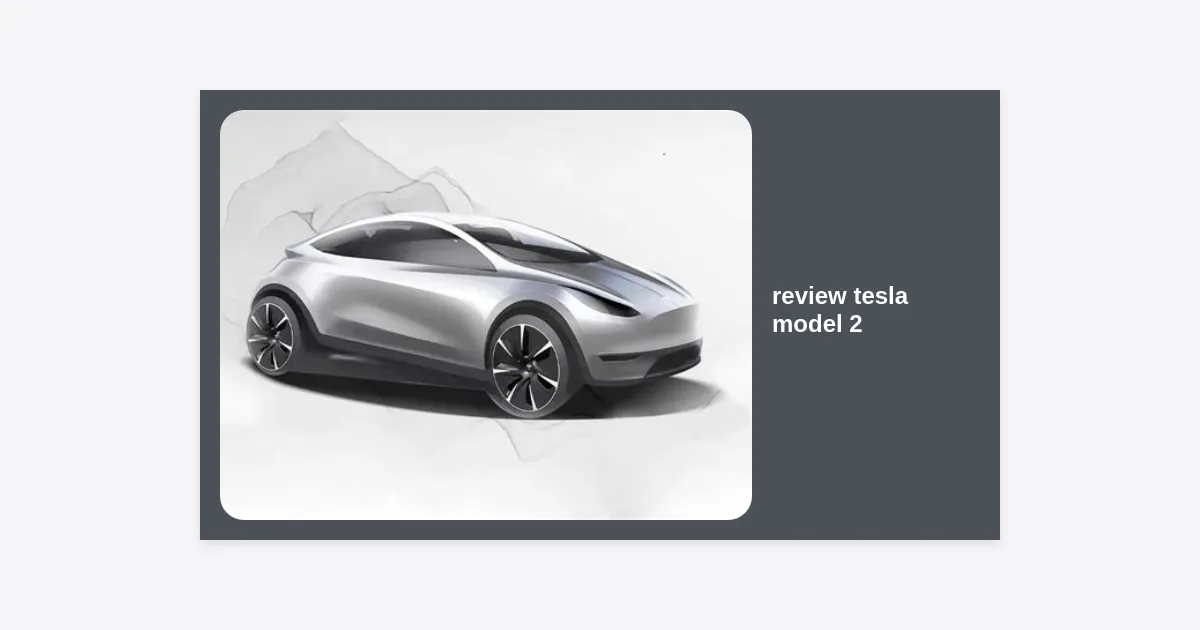
While official images are still under wraps, our review Tesla Model 2 analysis of patent filings and prototype sightings suggests a ‘baby Model Y’ aesthetic. Tesla has always prioritized aerodynamics to maximize range, and the Model 2 is no exception. Expect a sleek, hatchback-style silhouette with a sloping roofline that minimizes drag. This design choice is critical for a car with a smaller battery pack, as every bit of efficiency counts.
Rumors from the supply chain indicate that the Model 2 will be shorter than the Model 3, making it ideal for urban environments in Europe and Asia. However, thanks to the dedicated EV platform, the interior space is expected to rival much larger ICE vehicles. Short overhangs and a long wheelbase allow for a surprising amount of legroom despite the compact exterior footprint.
“The design language of the Model 2 will likely bridge the gap between the futuristic Cybertruck and the classic curves of the Model 3, creating a look that is both modern and approachable for the mass market.” — Automotive Design Analyst
We expect to see flush door handles, a panoramic glass roof (as an option or standard), and perhaps even the removal of traditional side mirrors in favor of cameras in markets where it is legal. These features don’t just look cool; they reduce air resistance, which is the primary enemy of electric range at highway speeds.
Performance Expectations: Speed and Efficiency
Even at a lower price point, a Tesla must perform like a Tesla. In our review Tesla Model 2 performance forecast, we anticipate a 0-60 mph time of approximately 5.5 to 6.5 seconds for the base model. While this isn’t ‘Plaid’ speed, it is significantly faster than almost any gasoline car in the $25,000 price bracket. This ‘zippiness’ is a hallmark of the Tesla driving experience and is unlikely to be sacrificed.
The car will likely be rear-wheel drive (RWD) in its most affordable configuration to save weight and cost. However, a Dual Motor All-Wheel Drive (AWD) version is almost certain to follow for those living in snowier climates or those desiring more grip. The handling is expected to be sharp, thanks to the low center of gravity provided by the floor-mounted battery pack.
Regenerative braking will again be a core feature, allowing for ‘one-pedal driving’ that many EV owners have grown to love. This not only makes city driving less fatiguing but also extends the life of the mechanical brakes and recovers energy that would otherwise be lost during deceleration.
Battery Technology: The LFP Advantage
The heart of any review Tesla Model 2 is the battery tech. To hit the $25,000 price target, Tesla is expected to utilize Lithium Iron Phosphate (LFP) batteries. Unlike the Nickel Manganese Cobalt (NMC) batteries found in long-range models, LFP batteries are cheaper to produce, more durable, and do not require cobalt—a mineral with significant ethical and supply chain challenges.
LFP batteries are also incredibly robust. They can be charged to 100% daily without significant degradation, which is a massive advantage for owners who want to get the full utility out of their vehicle. We expect a range of approximately 250 to 300 miles (400-480 km) on a single charge. For the average commuter who drives less than 40 miles a day, this is more than sufficient.
Charging speed will also be a priority. The Model 2 will undoubtedly utilize Tesla’s V4 Supercharging network, allowing for rapid top-ups during road trips. Even with a more budget-friendly battery architecture, owners can expect to gain 150 miles of range in about 15-20 minutes at a Supercharger location. This infrastructure remains Tesla’s ‘moat’ against all other competitors.
Interior and Technology: Minimalist Innovation
If you have seen the interior of a Highland Model 3, you have a good idea of what to expect here. In this review Tesla Model 2, we anticipate an even more radical adherence to minimalism to keep costs down. A single, centrally mounted 15-inch touchscreen will likely control 99% of the car’s functions, from climate control to navigation and entertainment.
Don’t expect a traditional instrument cluster behind the steering wheel. Tesla has proven that a clean dashboard improves visibility and simplifies the manufacturing process. The materials used will likely be sustainable and vegan-friendly, featuring high-quality fabrics and recycled plastics that look premium but cost less than leather or wood trim.
- FSD Readiness: Every Model 2 will come equipped with the hardware necessary for Full Self-Driving (Supervised).
- OTA Updates: Like all Teslas, the Model 2 will improve over time with over-the-air software updates.
- Audio System: Expect a simplified but high-fidelity audio system designed in-house to maximize space.
- Storage: A ‘frunk’ (front trunk) and a spacious rear hatch will offer best-in-class storage capacity.
The inclusion of the latest FSD hardware is a key selling point. Elon Musk has stated that the Model 2 is being designed with autonomy in mind, potentially even serving as the foundation for Tesla’s future Robotaxi fleet. This means the sensors and computing power inside this budget car will likely exceed those in many luxury vehicles from other brands.
The ‘Unboxed’ Manufacturing Process
The real secret sauce revealed in our review Tesla Model 2 analysis is the ‘Unboxed’ manufacturing method. Traditional car assembly involves moving a whole car body down a line while workers cram parts into it. Tesla plans to build the car in sub-assemblies—the front, the rear, the floorboard with seats attached—and only bring them together at the final moment.
This process reduces the factory footprint by 40% and allows more people (or robots) to work on the vehicle simultaneously without getting in each other’s way. It also eliminates the need for painting the entire shell at once, which is typically the most expensive and time-consuming part of car manufacturing. By painting only the necessary panels, Tesla saves billions in capital expenditure.
Furthermore, the Model 2 will likely feature a 48-volt architecture. This reduces the amount of copper wiring needed in the car, significantly lowering weight and cost while increasing efficiency for electronics. These technical innovations are what allow Tesla to maintain healthy profit margins while lowering the sticker price for the consumer.
Competitive Landscape: Tesla vs. The World
The compact EV market is becoming crowded. No review Tesla Model 2 would be complete without looking at the rivals. In China, BYD is already producing cars in this price range, such as the Dolphin and the Seagull. In Europe, the Volkswagen ID.2all and the Renault 5 EV are targeting the same demographic. In North America, the Chevrolet Bolt (and its successor) remains the primary budget contender.
Tesla’s advantage lies in three areas: Brand Equity, Software, and the Supercharger Network. While a BYD might be cheaper in certain markets, the Tesla ecosystem is a powerful draw. The ‘cool factor’ of owning a Tesla, combined with the seamless integration of the Tesla App and the reliability of their charging network, gives the Model 2 a significant head start.
However, the competition is fierce. Traditional automakers are catching up in battery technology and software. To win, Tesla must not only deliver on the $25,000 price but also ensure that the build quality and service experience meet the high expectations of first-time EV buyers who cannot afford the ‘early adopter’ headaches of previous generations.
Pricing and Availability
The magic number is $25,000. For many, this is the ‘tipping point’ where the total cost of ownership (TCO) for an EV becomes undeniably lower than a gasoline car. When you factor in federal tax credits in the US (such as the $7,500 IRA credit), the effective price of a Model 2 could drop to under $20,000 for eligible buyers.
Production is expected to begin at Giga Texas and eventually expand to Giga Mexico and Giga Berlin. While precise dates have shifted, internal goals suggest a ramp-up beginning in late 2025 or early 2026. Tesla famously prioritizes volume, so once the production lines are calibrated, we expect the Model 2 to become the world’s best-selling car, potentially surpassing the Model Y’s impressive records.
Potential buyers should keep an eye on official Tesla announcements regarding ‘Project Redwood.’ We recommend signing up for Tesla’s newsletter or following their investor relations page to get the first notification for pre-orders, as the waitlist is expected to be millions of people long within the first week.
Final Verdict: Review Tesla Model 2
In conclusion, our review Tesla Model 2 finds that this vehicle is arguably the most important car of the 21st century. It isn’t just a cheaper Tesla; it is a refined, highly engineered machine designed to democratize electric transport. If Tesla can deliver on its promises of 250+ mile range, 48-volt architecture, and the $25k price point, the era of the gasoline car will effectively be over for the mass market.
Key Takeaways:
- Affordability: A $25,000 price target changes everything for the average consumer.
- Efficiency: New LFP batteries and ‘unboxed’ manufacturing ensure high value.
- Technology: Full Self-Driving hardware remains standard, keeping the car future-proof.
- Strategy: This is Tesla’s ‘Corolla Moment’—the pivot to massive scale.
If you are looking for a car that offers the best technology in the world without the luxury price tag, the Tesla Model 2 is the car to watch. Its impact on the environment and the economy will be felt for decades. Stay tuned as we continue to update this review Tesla Model 2 with more specs and road-test data as it becomes available.
Looking for more information on the latest EV trends? [Download our 2025 EV Buying Guide here] to compare the Model 2 against its top competitors.