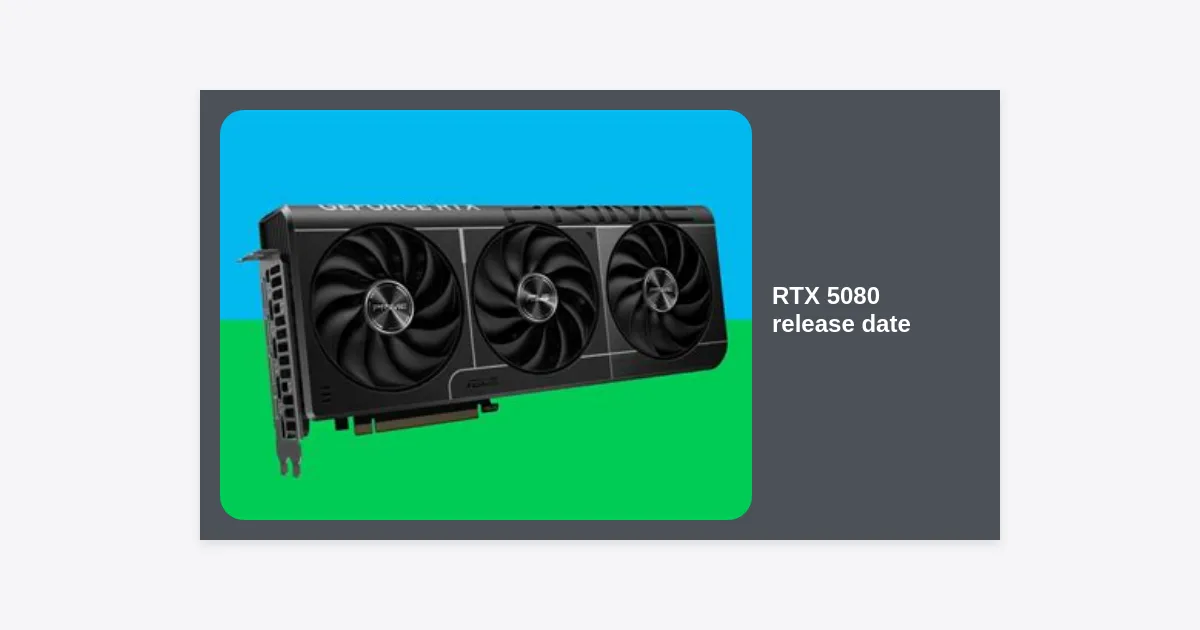
The gaming world is buzzing with anticipation as rumors regarding the RTX 5080 release date begin to solidify. For enthusiasts and professional creators alike, the jump from one GPU generation to the next represents more than just a frame rate increase; it is a leap in architectural efficiency, AI capabilities, and ray-tracing realism. As we move closer to the official unveiling of the Blackwell architecture, the question isn’t just “when,” but also “how much” and “how fast.”
Whether you are currently rocking a steady RTX 3080 or you skipped the 40-series entirely, the RTX 5080 is positioned to be the sweet-spot flagship for high-end 4K gaming. In this comprehensive guide, we will break down every leak, historical trend, and technical specification known so far about the RTX 5080.
The Expected RTX 5080 Release Date
Pinning down the exact RTX 5080 release date requires a look at NVIDIA’s historical cadence and the latest industry leaks. Historically, NVIDIA follows a two-year cycle for its flagship gaming GPUs. The RTX 30-series (Ampere) arrived in September 2020, and the RTX 40-series (Ada Lovelace) launched in October 2022.
Current insider reports and supply chain leaks suggest that NVIDIA has shifted its focus slightly. While many expected a late 2024 launch, the prevailing consensus among leakers like kopite7kimi points toward a CES 2025 announcement in January, with retail availability following shortly after.
- Announcement Window: January 2025 (CES Keynote)
- Early Retail Availability: Late January or February 2025
- Pre-order Phase: Expected within 7 days of the official announcement
NVIDIA’s CEO, Jensen Huang, is scheduled to deliver a keynote at CES 2025, which is widely believed to be the stage for the “GeForce RTX 50-series” reveal. Unlike previous generations where the 90-class card launched first, rumors suggest the RTX 5080 might actually launch alongside or even slightly before the RTX 5090 to capture the mainstream high-end market faster.
The Blackwell Architecture: What’s New?
At the heart of the RTX 5080 is the new Blackwell architecture. Named after mathematician David Blackwell, this architecture is already making waves in the data center sector (via the B100 and B200 AI chips). For gamers, the consumer-grade Blackwell (GB203 die for the 5080) brings several key innovations.
The Shift to TSMC 4NP Process
NVIDIA is expected to utilize a custom TSMC 4NP (5nm class) process node. This refined node allows for higher transistor density and better power efficiency compared to the 4N node used in the RTX 40-series. This means more CUDA cores packed into the same physical space without the chip becoming an uncontrollable furnace.
Improved RT and Tensor Cores
Ray tracing performance remains NVIDIA’s crown jewel. The 4th Generation RT cores in Blackwell are rumored to feature hardware-accelerated micro-mesh technology, which could drastically reduce the performance hit when playing titles with path tracing (Full Ray Tracing) like Cyberpunk 2077 or Alan Wake 2.
“Blackwell isn’t just an incremental update; it’s a foundational shift in how NVIDIA handles geometry and AI-driven upscaling, potentially making native 4K gaming a secondary concern to AI-reconstructed 8K.” – Tech Industry Analyst
Expected Technical Specifications
The RTX 5080 is rumored to use the GB203 GPU die. This is a significant distinction from the RTX 5090, which will use the massive GB202 die. While the 5080 will have fewer cores than its big brother, the inclusion of GDDR7 memory is a game-changer.
Memory: The GDDR7 Revolution
Perhaps the most exciting spec for the RTX 5080 is the transition to GDDR7 VRAM. GDDR7 offers significantly higher bandwidth than GDDR6X, with speeds potentially reaching 28Gbps to 32Gbps. Even with a 256-bit memory bus, the total bandwidth could exceed what the RTX 4090 currently offers.
| Feature | RTX 4080 (Lovelace) | RTX 5080 (Blackwell – Rumored) |
|---|---|---|
| CUDA Cores | 9,728 | 10,752 – 11,520 |
| Memory Type | GDDR6X | GDDR7 |
| Memory Clock | 22.4 Gbps | 28 – 32 Gbps |
| VRAM Capacity | 16 GB | 16 GB / 20 GB (Variants) |
| Bus Width | 256-bit | 256-bit |
While some enthusiasts were hoping for a 384-bit bus, the efficiency of GDDR7 means that the RTX 5080 will not be bottlenecked at 4K resolutions. The increased L2 cache—rumored to be around 64MB—will also help in reducing memory latency.
Performance Expectations: 5080 vs. 4090
How will the RTX 5080 perform compared to the current king, the RTX 4090? Early leaks suggest that the RTX 5080 will target performance levels that either meet or slightly exceed the RTX 4090 in traditional rasterization, while definitely beating it in heavy ray-tracing scenarios.
Rasterization: In standard rendering (non-RT), expect a 10-15% uplift over the RTX 4080 Super, putting it neck-and-neck with the 4090.
Ray Tracing: This is where Blackwell will shine. Due to the updated RT cores, the RTX 5080 could see a 20-30% improvement over the 4080 Super in games utilizing path tracing.
DLSS 4 / AI: There are strong rumors that NVIDIA will introduce DLSS 4 with the 50-series. This could include “Multi-Frame Generation” or AI-driven texture enhancement, which would be exclusive to Blackwell hardware, further widening the gap between generations.
Power Consumption and PSU Requirements
Power efficiency is a double-edged sword with the 50-series. While the Blackwell architecture is more efficient per-watt, NVIDIA is reportedly pushing the power limits to achieve maximum performance. The TGP (Total Graphics Power) for the RTX 5080 is rumored to be around 350W to 400W.
The 12V-2×6 Connector: NVIDIA is likely to move away from the original 12VHPWR connector in favor of the refined 12V-2×6 standard. This updated connector is designed to be safer, with shorter sense pins to ensure the cable is fully seated before delivering full power, preventing the melting issues seen on some early 4090 cards.
If you are planning to build a PC around the RTX 5080 release date, we recommend a minimum 850W ATX 3.0 or 3.1 power supply. This will ensure you have the necessary native cables and the transient spike headroom required by high-end Blackwell GPUs.
Estimated Pricing and Market Positioning
The pricing of the RTX 5080 is a subject of intense debate. The RTX 4080 launched at a controversial $1,199, which was later adjusted with the $999 RTX 4080 Super. Given the lack of strong high-end competition from AMD (who are reportedly focusing on the mid-range with RDNA 4), NVIDIA has significant pricing power.
- Expected MSRP: $999 – $1,199
- Founder’s Edition: Likely $1,099
- AIB Models (ASUS, MSI, Gigabyte): $1,199 – $1,399
While a $999 price point would be a massive win for consumers, the cost of GDDR7 and TSMC’s advanced nodes makes $1,099 or $1,199 more realistic for the RTX 5080. NVIDIA will likely position it as the “ultimate 4K card,” while the 5090 remains in the “ultra-enthusiast/workstation” category at $1,599 or higher.
Upgrade Guide: Should You Wait for the RTX 5080?
Deciding whether to buy a GPU now or wait for the RTX 5080 release date depends on your current setup. Here is our practical advice for different scenarios:
If you have an RTX 3080 or older: Keep waiting. The jump from Ampere to Blackwell will be massive, offering roughly 2x the performance in Ray Tracing and access to the latest DLSS features. It is the perfect time for an upgrade.
If you have an RTX 4080 or 4090: You are likely safe. Unless you absolutely must have the latest technology for professional work or 8K gaming, a 40-series card will remain highly capable for the next 2-3 years. The RTX 5080 will be faster, but it won’t render your 4080 obsolete overnight.
If you are building a new PC today: If you can’t wait until 2025, consider a mid-range card like the RTX 4070 Super as a “placeholder” or buy a 4080 Super now if you find a great deal. However, if your budget is strictly $>1,000, waiting those extra few months will likely yield a much better product.
Final Thoughts and Next Steps
The RTX 5080 release date is set to be one of the biggest moments in tech for 2025. With the introduction of GDDR7 memory, the Blackwell architecture, and advancements in AI-driven rendering, NVIDIA is poised to extend its lead in the GPU market. While the 5090 will grab the headlines for its raw power, the 5080 will likely be the card that defines the high-end gaming experience for the coming years.
Key Takeaways:
- The RTX 5080 is expected to be announced at CES 2025 (January).
- It will likely feature GDDR7 memory and the Blackwell architecture.
- Performance is expected to rival or exceed the RTX 4090.
- Pricing will likely fall between $999 and $1,199.
As we wait for the official reveal, stay tuned to reputable tech outlets and keep an eye on NVIDIA’s social channels. The next era of PC gaming is just around the corner, and the RTX 5080 is at the forefront of that revolution. Make sure your power supply is ready and your monitor can handle the 4K high-refresh-rate onslaught that is coming.