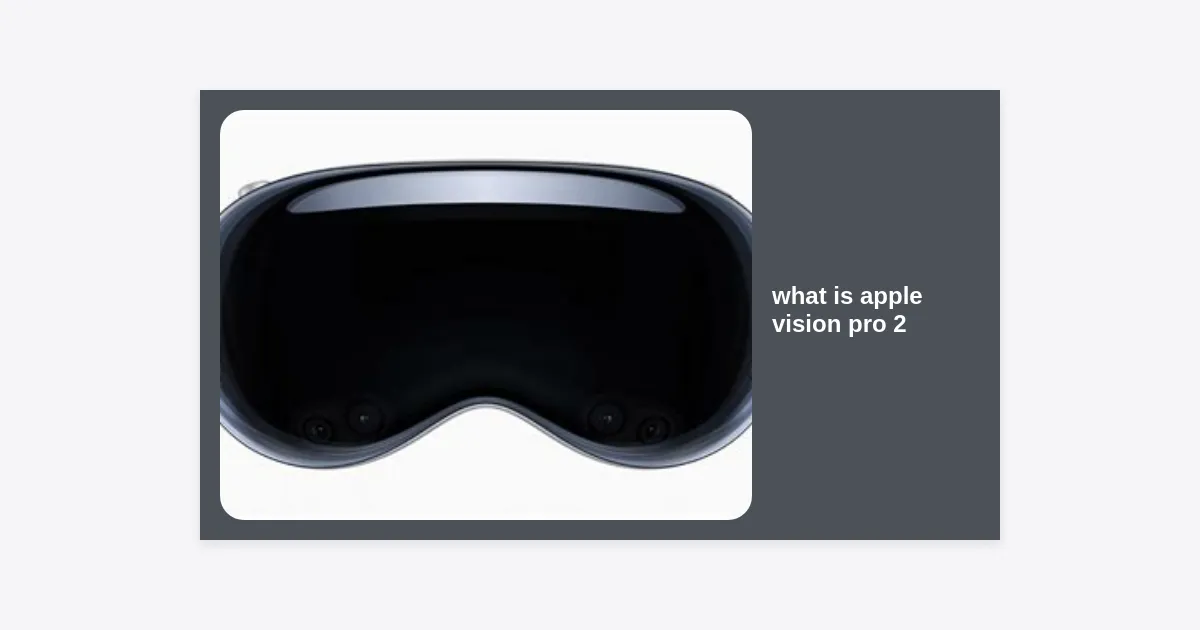
When the first Apple Vision Pro hit the shelves, it didn’t just launch a new product; it launched an entire category that Apple calls “spatial computing.” However, as with any first-generation technology, early adopters and tech enthusiasts are already looking toward the horizon. What is Apple Vision Pro 2, and how will it improve upon the ambitious but heavy and expensive predecessor? In this comprehensive guide, we dive into every rumor, supply chain report, and technical specification currently known about Apple’s next-generation mixed-reality headset.
Table of Contents
- Defining the Next Generation: What is Apple Vision Pro 2?
- Technical Specifications and Hardware Upgrades
- Design Enhancements: Prioritizing Comfort and Weight
- The Cutting Edge of Display Technology
- Battery Life and Power Management
- Expected Release Date and Launch Cycles
- Pricing Speculation: Will It Get Cheaper?
- Professional vs. Consumer Use Cases
- Vision Pro 2 vs. The Competition
- Buying Advice: Should You Wait?
- Conclusion: The Verdict on Apple’s Spatial Future
Defining the Next Generation: What is Apple Vision Pro 2?
To understand what is Apple Vision Pro 2, one must first look at the legacy of the original Vision Pro. Released in early 2024, the first iteration was a glass-and-aluminum marvel featuring M2 and R1 chips, micro-OLED displays with 23 million pixels, and a sophisticated sensor array.
The Apple Vision Pro 2 is the anticipated successor that seeks to address the “pain points” of the first generation. This includes the massive weight of the device, the external battery pack’s limitations, and the high entry price. Effectively, the Vision Pro 2 will be the refined, more powerful, and potentially more accessible version of Apple’s spatial computer, likely integrating the upcoming M5 silicon family.
Technical Specifications and Hardware Upgrades
If you are asking what is Apple Vision Pro 2 in terms of raw power, the answer lies in Apple’s Silicon roadmap. While the current model uses the M2, rumors suggest that Apple may skip the M3 and M4 generations for the headset, jumping straight to an M5 processor. This chip would provide the necessary computational headroom for more complex AI tasks and improved Ray Tracing for realistic gaming.
- Processor: Apple M5 (Expected) with an updated R-series co-processor.
- Memory: 16GB or higher Unified Memory to handle visionOS 3.0 or 4.0.
- Sensors: Enhanced TrueDepth camera system for better hand tracking in low-light environments.
- Audio: Improved spatial audio drivers with lower latency when paired with AirPods Pro.
“Apple’s transition to the M5 chip for the Vision Pro 2 suggests a focus on AI-driven spatial environments that were previously impossible with M2 architecture.” — Industry Analyst Rumor Report.
Design Enhancements: Prioritizing Comfort and Weight
The most common complaint regarding the initial Vision Pro was its weight, which ranges from 600 to 650 grams. Users often experienced “neck fatigue” after more than an hour of use. So, what is Apple Vision Pro 2 doing to solve this? Supply chain reports from Ming-Chi Kuo suggest that Apple is experimenting with lighter materials, possibly moving away from the heavy magnesium and aluminum frame to specialized carbon fiber or lighter alloys.
Additionally, the “Solo Knit Band” and “Dual Loop Band” are expected to receive ergonomic overhauls. The goal is a more balanced weight distribution so the center of gravity sits closer to the user’s face, reducing the leverage effect that causes discomfort.
The Cutting Edge of Display Technology
The displays are the centerpiece of the device. Currently, the Vision Pro uses 4K micro-OLED panels per eye. For the second generation, Apple is reportedly working with Sony and potentially Samsung to increase brightness and energy efficiency. An increase in brightness is crucial for the “passthrough” feature (EyeSight), making the user’s eyes look more natural to people outside the headset.
There is also talk of moving to a tandem OLED technology, similar to what is seen in the 2024 iPad Pro. This would allow for higher peak brightness for HDR content without significantly draining the battery or generating excessive heat.
The EyeSight Evolution
EyeSight, the external display that shows a digital version of your eyes, was met with mixed reviews. In the Vision Pro 2, we expect a higher-resolution external panel and better glass optics to make the persona appear less “ghostly” and more lifelike.
Battery Life and Power Management
The external battery pack remains a controversial design choice. When exploring what is Apple Vision Pro 2, many wonder if the battery will finally move inside the headset. Most experts believe this is unlikely due to the weight it would add. However, the Gen 2 battery is expected to offer better density, potentially pushing the 2-hour limit to a more respectable 3.5 or 4 hours of continuous use.
Expected Release Date and Launch Cycles
Apple typically follows a predictable release cycle for iPhones, but new product categories like the Vision Pro are different. Analysts suggest that we might not see the Apple Vision Pro 2 until late 2025 or even 2026. Apple wants to ensure that the visionOS ecosystem has matured and that the hardware improvements are significant enough to warrant an upgrade.
According to Bloomberg’s Mark Gurman, Apple’s focus might also be split between a high-end Pro 2 and a more affordable standard “Apple Vision” to capture a wider market share before the Pro 2 arrives.
Pricing Speculation: Will It Get Cheaper?
The current $3,499 price tag is the biggest barrier to entry. While the “Pro” moniker implies a premium price, Apple is likely looking for ways to optimize the supply chain. For the Vision Pro 2, we might see a slight reduction, perhaps to $2,999, though it is more likely that Apple will keep the Pro at a high price and release a non-pro model at $1,500 – $2,000.
Professional vs. Consumer Use Cases
When asking what is Apple Vision Pro 2 intended for, the answer is dual-purpose: professional productivity and high-end entertainment. With the M5 chip, the Vision Pro 2 could replace multiple monitor setups for coders, editors, and stock traders entirely.
- Architecture: Designing in 3D with 1:1 scale visualization.
- Surgery: Augmented reality overlays for medical training.
- Cinema: A 100-foot theater experience with improved Dolby Vision support.
- Gaming: Integration with Mac gaming to provide a more immersive VR gaming experience.
Vision Pro 2 vs. The Competition
Apple doesn’t exist in a vacuum. Meta, Sony, and Samsung are all working on rival headsets. The Meta Quest Pro 2 is rumored to focus on a lighter build and social integration. However, Apple’s advantage remains its ecosystem. The seamless hand-off between iPhone, Mac, and Vision Pro is something other manufacturers struggle to replicate.
Buying Advice: Should You Wait?
Are you considering the current model, or are you waiting for what is Apple Vision Pro 2? Here is a simple breakdown to help you decide:
- Buy Now If: You are a developer who needs to build for the platform, or an early adopter who wants the “future” today and doesn’t mind the weight.
- Wait If: You find the current headset too heavy, you want a more mature app store, or you are waiting for a more palatable price point.
Conclusion: The Verdict on Apple’s Spatial Future
In summary, what is Apple Vision Pro 2? It is the refined vision of a future where our digital and physical worlds are indistinguishable. By focusing on a lighter design, the powerful M5 chip, and improved display optics, Apple is positioning the Vision Pro 2 as more than just a niche gadget for tech enthusiasts.
While we are still a year or more away from an official announcement, the trajectory is clear. Apple is committed to spatial computing. Whether it becomes as ubiquitous as the iPhone remains to be seen, but the improvements slated for the second generation will undoubtedly bring it one step closer to that reality.
Stay tuned to our blog for updates as more leaks emerge from the supply chain. The journey into spatial computing is only just beginning!